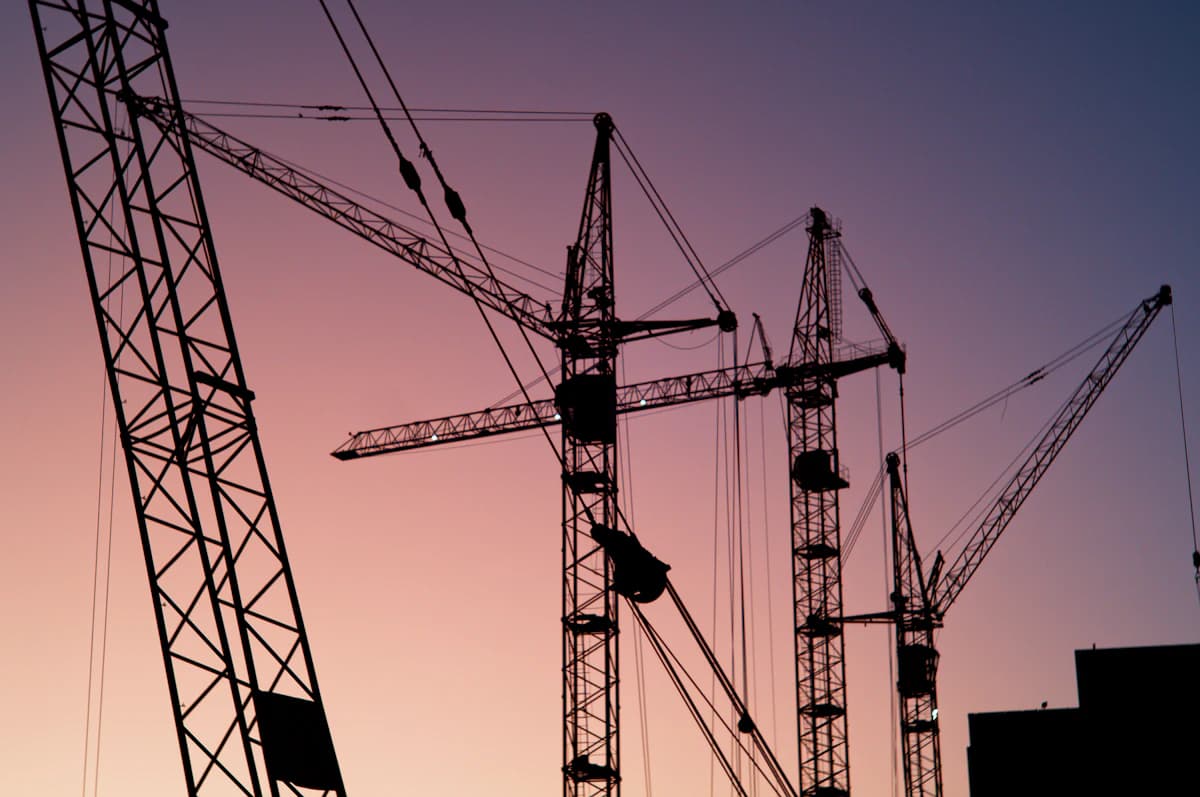
Construction M&A
Thinking about selling your construction company?
Backlog, bonding, and the people who run your jobs are what a buyer is really acquiring. We help owners of general contractors, heavy civil firms, and specialty trade contractors understand what buyers pay for, and run a confidential sale when the time is right.
- U.S. construction put in place, 2025
- $2.24 trillion[1]
- Total value of construction work done in calendar 2025
- Private nonresidential construction, 2025
- $784 billion[1]
- Below the 2024 high of $797 billion; up from $597 billion in 2022
- Open construction jobs, August 2026
- 251,000[3]
- Seasonally adjusted; preliminary and subject to revision
The construction market in brief
U.S. construction spending reached $2.24 trillion in 2025, according to Census. About $1.31 trillion of that was nonresidential work, with private owners accounting for about $784 billion and public owners about $524 billion. Private nonresidential spending rose from $597 billion in 2022 to a high of $797 billion in 2024, then eased in 2025.[1]
Most construction establishments are small. Census counted 814,557 construction establishments with employees in 2023, and about nine in ten had fewer than 20 employees. Specialty trade contractors, such as electrical, mechanical, concrete, and site work firms, make up the largest group, at 521,315 establishments.[2]
Labor is the constraint buyers price in. Construction employed about 8.4 million people in September 2026, and employers reported about 251,000 open positions in August 2026. A company that can staff its work, with project managers and superintendents who stay, tends to stand out.[4],[3]
In the specialty trades in particular, buyers often build regional businesses one acquisition at a time, so an unsolicited call is not unusual.
What buyers pay for in a construction company
Earnings matter, but buyers also study whether those earnings will continue under new ownership: the work ahead, the people who deliver it, and the capacity to bid more.
Backlog with margin
Signed and awarded work shows a buyer what revenue looks like after closing. It carries the most weight when job cost history shows the company has earned its estimated margins and win rates on recent bids are documented.
A project management bench
Project managers, estimators, and superintendents who can run work without the owner are what make a construction company transferable. Buyers look at tenure, compensation, and who holds the client relationships.
Bonding capacity and surety relationships
Single and aggregate bonding limits set how much public and large private work a company can take on. A long, clean surety relationship tells a buyer the company has managed risk well.
Repeat and negotiated work
Customers who return, and work won through negotiation rather than low bid, generally signal pricing power and a lower cost to win work.
Safety record
A low experience modification rate and a documented safety program open doors with owners who prequalify contractors, and they reduce insurance cost.
Self-performed scopes
Companies that perform their own concrete, steel, mechanical, or site work control schedule and margin on more of each job, which buyers generally value.
What gets discounted when you sell a construction company
Buyers price these risks into the number or into the deal structure.
One customer or one project
When a single owner, general contractor, or project makes up a large share of revenue, the business is exposed if that relationship ends.
Profit fade
Jobs that finish below their estimated margin raise questions about estimating and project control across the backlog.
Owner-held estimating and relationships
If the owner prices every job and holds the key client relationships, a buyer has to plan for that leaving with the seller.
Underbilled work in progress
Costs incurred ahead of billings tie up cash and can hide problem jobs. Buyers review over and under billings closely.
Claims and disputes
Open claims, liens, or litigation create uncertainty that buyers usually address through escrows or indemnities.
Who buys construction companies
Each type of buyer values backlog, bonding, and people differently. Reaching more than one is generally how an owner learns what the company is worth.
Private equity backed platforms
Investment firms building regional businesses, especially in the specialty trades, through a first platform acquisition and later add-ons.
Looks for: A management team that stays, recurring customers, and room to grow.
Regional and national contractors
Larger contractors adding a new geography, a new type of work, or self-performed scopes they currently subcontract.
Looks for: Backlog, licenses, bonding history, and crews in the markets they want.
Management and employee buyers
Key employees buying the company, sometimes with outside financing or through an employee stock ownership plan.
Looks for: Steady cash flow to support financing and a gradual transition from the owner.
Construction company due diligence: what to prepare
These are the records buyers ask for first. Owners who gather them before going to market generally move faster and face fewer late surprises.
Work-in-progress schedules
Monthly or quarterly WIP schedules showing estimated cost, cost to date, percent complete, and over and under billings for every open job.
Backlog detail
Signed and awarded contracts with contract value, estimated margin, schedule, and customer.
Job cost history
Completed jobs over several years, comparing estimated and actual margin, to show how reliable the estimating is.
Surety and insurance
A letter from the surety on current limits and history, plus insurance policies and loss runs.
Safety records
OSHA logs, the experience modification rate, the written safety program, and any citations and how they were resolved.
People and equipment
An organization chart, key employee agreements and compensation, and an equipment list with age and condition.
Questions owners ask about selling a construction company
How much is my construction company worth?
Value generally depends on earnings and how likely they are to continue: backlog with margin, a management team that can run work without the owner, bonding capacity, and customer mix. Two companies with similar revenue can be valued very differently once a buyer reviews job cost history and work-in-progress schedules. A review of several years of results is usually the starting point.
Does backlog matter when I sell my construction company?
Yes. Backlog shows a buyer what revenue looks like after closing, and it generally carries the most weight when job cost history shows the company earns its estimated margins. Buyers review the margin in backlog, not just the size, and look for profit fade on recent jobs. Backlog that depends on one customer is usually weighed more cautiously.
How do buyers treat bonding capacity?
Bonding capacity sets how much work a company can take on, so buyers look at single and aggregate limits and the surety relationship. If the owner’s personal indemnity supports the bonds, the buyer arranges bonding for new work, while the owner often stays on the indemnity for existing bonds until those jobs close out or the surety releases it. Raising bonding early in a sale helps keep it from delaying the closing.
Are specialty trade contractors valued differently from general contractors?
Often, yes. Specialty contractors that self-perform work, such as electrical, mechanical, or concrete, may have more control over margin and more repeat customers than a general contractor that subcontracts most of each job. General contractors are typically valued on backlog, client relationships, and project management depth. Much depends on the mix of negotiated and bid work.
What happens to my project managers and crews when I sell?
Most buyers want the people who run the work to stay, because they are much of what the buyer is acquiring. Retention plans, employment agreements, or equity for key managers are common parts of a deal. Telling employees at the right time, usually late in the process, helps protect the business while a sale is under way.
How long does it take to sell a construction company?
A prepared sale process commonly runs several months from launch to closing. Diligence on work-in-progress schedules, bonding, and open claims tends to take the longest. Owners who organize job cost history, surety letters, and safety records before going to market generally move faster and face fewer surprises late in the process.
Related reading
- Construction transaction services guide
How a construction company sale is structured and run.
- Strategic vs financial buyers
How each type of buyer approaches a construction business.
- Steel Fabrication M&A
Fabricators and erectors serving commercial and industrial projects.
- Paving & Asphalt M&A
Paving contractors and hot mix asphalt producers.
- HVAC & Mechanical M&A
Service-driven mechanical contractors.
Sources
- [1] U.S. Census Bureau, Annual Value of Construction Put in Place, 2022 to 2025, July 2026 annual revision. View source
- [2] U.S. Census Bureau, County Business Patterns: 2023, NAICS 23 Construction, 2025 release (2023 data). View source
- [3] U.S. Bureau of Labor Statistics, Job Openings and Labor Turnover Survey: Construction Job Openings (JTS230000000000000JOL), Released September 29, 2026 (August 2026 data). View source
- [4] U.S. Bureau of Labor Statistics, Current Employment Statistics: Construction Employment (CES2000000001), September 2026 data, preliminary. View source